
PH BUSINESS CONFIDENCE TURNS NEGATIVE
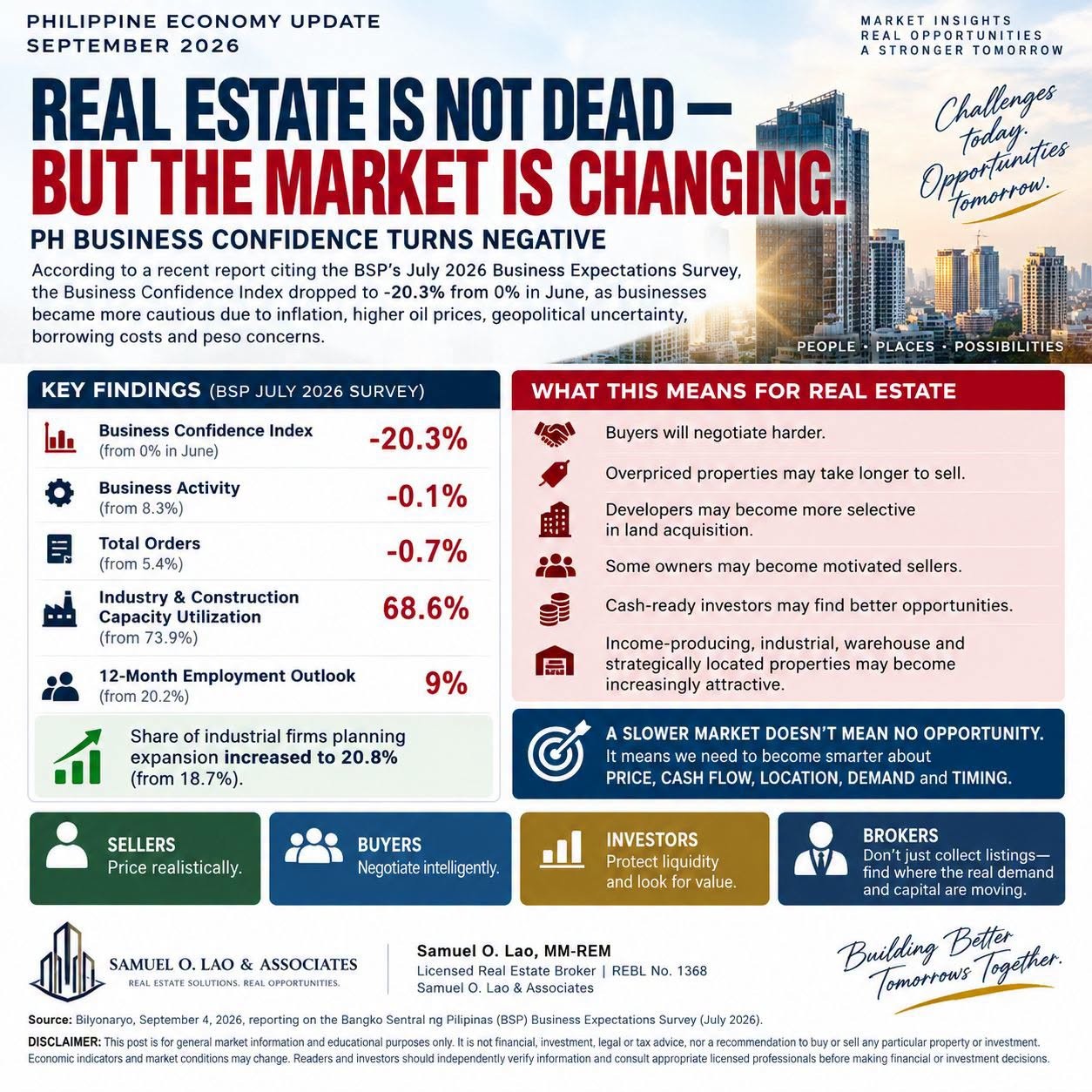
PH Business Confidence Turns Negative: What It Means for Philippine Real Estate
According to the Bangko Sentral ng Pilipinas (BSP) Business Expectations Survey released in early September 2026, Philippine business sentiment experienced a sharp deterioration. The Business Confidence Index plunged to -20.3% in July from a neutral 0% in June.
Driven by concerns over rising inflation, elevated oil prices, geopolitical tensions, persistent borrowing costs, and foreign exchange fluctuations, local enterprises have turned increasingly cautious.
Key Economic Indicators at a Glance
-
Business Confidence Index: -20.3% (down from 0% in June)
-
Business Activity: -0.1%
-
Total Orders: -0.7%
-
Industry & Construction Capacity Utilization: 68.6%
-
12-Month Employment Outlook: 9.0%
Warning Signal vs. Economic Crisis
While a negative reading indicates that pessimists outnumber optimists, this shift signals a period of heightened corporate caution rather than a full-scale economic contraction like the COVID-19 pandemic.
When sentiment turns negative, companies often delay major capital expenditures, freeze headcount expansion, and postpone secondary office or branch rollouts. This operational hesitation directly ripples into the commercial and residential real estate sectors.
Real Estate Market Implications
In a cautious economic environment, expect several structural shifts across buying, selling, and development behaviors:
-
Price Sensitivity: Buyers and occupiers will scrutinize valuations and seek flexible terms or discounts.
-
Selective Development: Property developers will tighten land acquisition criteria, focusing exclusively on prime, high-yield locations.
-
Extended Selling Timelines: Overpriced inventory will linger on the market as prospective buyers adopt a wait-and-see approach.
-
Liquid Capital Advantage: Motivated sellers seeking immediate liquidity will create prime negotiating opportunities for cash-ready investors.
Emerging Bright Spots: Industrial and Logistics
Despite general headwinds, sector-specific opportunities remain strong. Notably, the BSP report highlighted that the share of industrial firms planning expansion actually increased to 20.8% from 18.7%.
This divergence underscores resilience in specific asset classes:
-
Industrial & Warehousing: Growth in e-commerce, regional logistics, and supply chain localization continues to drive industrial demand.
-
Income-Producing Commercial Assets: Stable, cash-flow-generating properties offer reliable yields against market volatility.
-
Strategic Land Banks: Realistically priced development land presents long-term upside for patient capital.
Strategic Action Plan for Market Participants
| Stakeholder | Recommended Strategy |
| Sellers | Price properties realistically to align with tight market liquidity and secure active buyers. |
| Buyers & Investors | Preserve cash reserves, negotiate assertively, and focus on steady rental yields over speculative appreciation. |
| Brokers & Advisors | Shift focus from passive listing collection to identifying capital flows, niche demand, and distress-value deals. |
The Philippine property market is evolving rather than shrinking. Success in this cycle will depend on strategic selection, rigorous due diligence, precise valuation, and disciplined timing.